Summary
For many seniors, pill schedules are difficult to adhere to both because of complicated medication schedules and increasing forgetfulness. Personally, both my grandmothers have been diagnosed with Alzheimer’s, and it is very common for them to either forget, or mix up their medications. My parents, their primary caregivers, live a distance away, and it is difficult for them to keep track of their parents medication schedules. To address this problem, I designed and built a Smart Pillbox, with technology to sense when seniors have not taken their pills, and the ability to contact patients and caregivers with reminders and alerts. The final pillbox is able to tweet and text reminders to patients, primary caregivers, and a network of secondary caregivers.
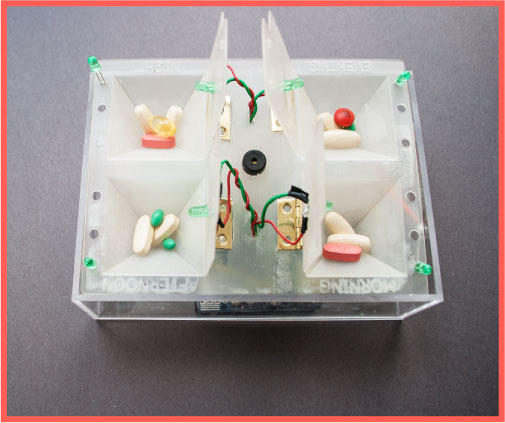
The Problem: Alzheimer’s disease is one of the top ten diseases in the US. As a result of memory loss, Alzheimer’s patients often do not take medications as prescribed. Even aside from Alzheimer’s, 55% of adults who receive a prescription fail to take it as advised by their doctor. Non-adherence to medication schedules has serious health consequences.
Research: I identified the pros and cons of electronic pillboxes currently on the market. All fall into the following categories:
- Missing important functionality (feature a single reminder; do not keep caregivers in the loop, etc.)
- Too complex for seniors to easily operate
- Have great features, but are too expensive ($750+)
Engineering Goal: The design and construction of a pillbox with a built-in alarm and multi-action reminder system that assists patients and their caregiver(s) in adhering to medication schedules, at an affordable cost.
Design Criteria:
- Four compartments: Morning, Noon, Evening, Night
- Individual compartments that can sense the presence of pills
- An alarm that consists of flashing LEDs and beeping piezoelectric buzzers to attract attention
- A way to contact the patient and the primary caregiver; and then, if medication remains in pill compartment, secondary caregiver(s) as well.
Prototype Development


Technologies Used in Final Prototype:
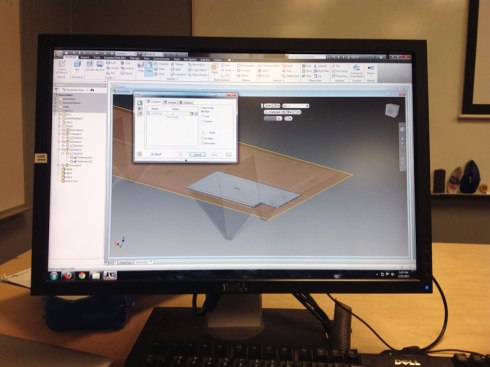
- Arduino open-source platform (UNO)
- Ethernet Shield for time and Twitter + SMS
- Photo resistors (light sensors)
- LEDs and Piezo buzzer
- Autodesk Inventor 3D modeling software
- ProJet HD 3000 3D printer
How It Works:
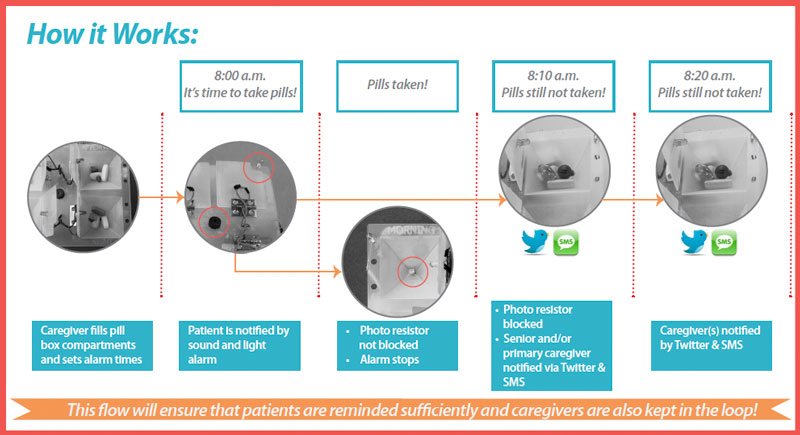
Testing (mostly to ensure photo resistors can accurately detect presence of pills):
- Tested under various lighting conditions: natural, dim, and fluorescent
- Tested with different pill sizes: large, medium, and small
- Tested both opaque and translucent pills in each of the other two tests
Features to Work On:
Improve user experience:
- Add LCD screen with push buttons to set alarm times
- Set up a wizard to assist users to easily add Twitter accounts to app
- In addition to sending tweets and texts, give users the options of receiving calls and/or emails
- Research to calculate manufacturing cost
 Leela Amladi